Spooky Maths: 10 Halloween Activities That Are Secretly Curriculum Practice
Ten Halloween maths and writing activities for children aged 7–11, each with its year group and curriculum objective. Free printable pack included.
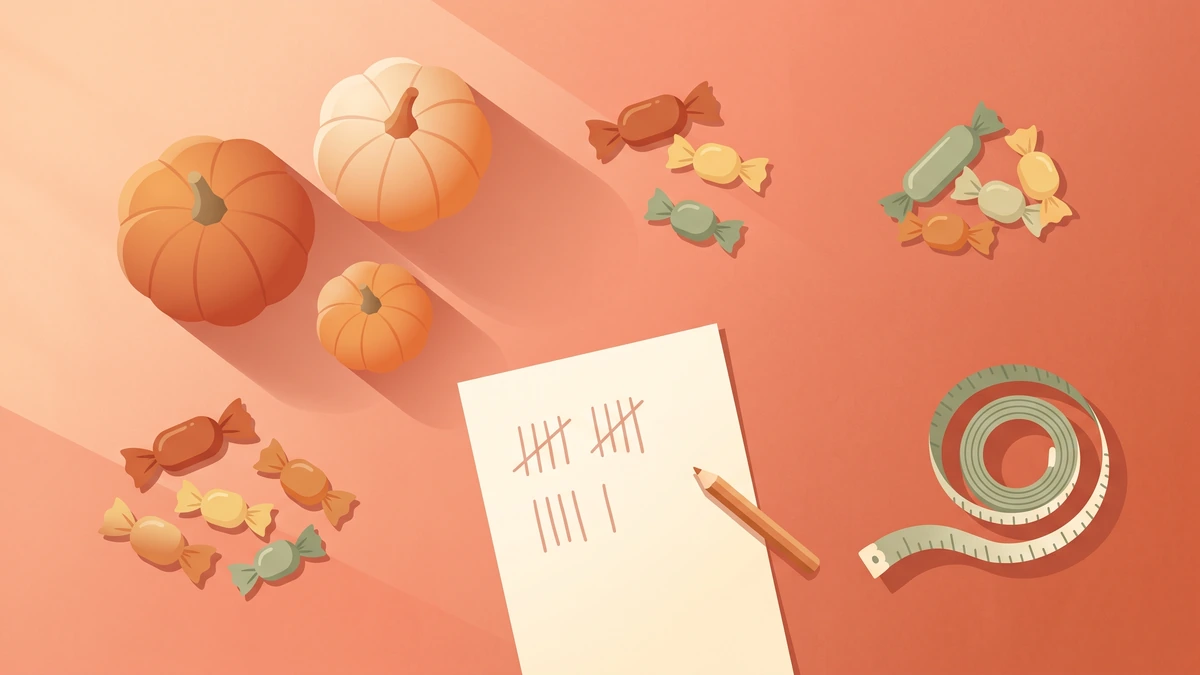
Halloween lands at the end of October half term, which means most parents are looking at a week off, a house full of sweets and a child who has firmly stopped doing anything that looks like schoolwork. Good news: almost everything about Halloween is already maths. Estimating, weighing, sorting, budgeting, measuring, symmetry — it is all there, and children will do it happily because nobody has called it practice. Each activity below takes twenty to thirty minutes, uses what you already have in the house, and names the year group and objective it covers so you can pick the right level.
Why themed practice works
Novelty lowers resistance. A child who groans at a worksheet of division questions will cheerfully share out eighty-four sweets between four people, because the sweets are real and the answer matters to them. The maths is identical. What changes is that the emotional guard comes down — which matters enormously for children who have decided they are "bad at maths".
The rule I give parents is that the theme should be the packaging, never the content. If an activity is all glitter and no thinking, skip it. Every one of these has a curriculum objective attached.
1. The pumpkin investigation
Years 3–4 — estimation, mass, data collection
Before you carve, ask three questions and write down the guesses: how heavy is it, how many seeds are inside, how far around is it? Then weigh it, measure the circumference with a tape or a piece of string, and count the seeds in groups of ten once they are out. Compare guesses to reality and talk about who was closest and why.
The learning is in the estimate, not the count. Children who habitually estimate before calculating make far fewer catastrophic errors in written work later on.
Make it harder: weigh the pumpkin before and after scooping and work out the percentage of the mass that was flesh and seeds.
2. The trick-or-treat sort
Years 4–5 — tally charts, bar charts, fractions
Tip the haul out and sort it: by type, by brand, by colour, by whether it is chocolate. Make a tally chart, then draw a bar chart with a sensible scale — choosing the scale is the real skill, and most children default to one square per item until someone makes them think.
Then the fraction questions. What fraction of the haul is chocolate? Simplify it. If you eat all the chocolate, what fraction is left?
Make it easier: sort into three categories only and count in twos.
3. Sweet-shop budgeting
Years 5–6 — money, percentages, multi-step problems
Give a budget — say £15 — and a real shop. Multipack prices online or a photographed shelf both work. The task is to buy enough to hand out to thirty trick-or-treaters without going over, and to show the working.
Then add the twist that makes it Year 6: one product is on a "3 for 2", another has 20% off. Which is genuinely better value per sweet? This is unit-price reasoning, and it is one of the most useful pieces of maths an eleven-year-old can own.
4. Costume geometry
Years 4–5 — 2D and 3D shape, nets, symmetry, measurement
Making a witch's hat is making a cone from a net, and children discover quickly that guessing the size does not work. Measure the head circumference, work out the radius you need, draw the sector, tape it up, test it, adjust. A cape is a measuring and estimating exercise — length from neck to knee, plus a bit for the hem.
Spiders and bats are symmetry: fold, draw half, cut, open. Ask where the line of symmetry is and whether the shape has any rotational symmetry too.
5. The 100-word horror story
Years 4–6 — narrative writing, precision of vocabulary
Exactly one hundred words. Not ninety-nine, not a hundred and one. It must have a beginning, a turn and a last line that unsettles the reader.
The word limit is the whole point. It forces children to cut the padding they normally rely on and choose stronger verbs, and counting the words is a legitimate reason to reread their own writing — something they will otherwise never do. Three starters: The last pumpkin on the porch was still warm. / Nobody had knocked. The sweets were gone anyway. / The costume did not fit yesterday.
6. Haunted-house scale drawing
Year 6 — scale, area, perimeter
Draw a floor plan of a haunted house on squared paper where one square is one metre. Six rooms, a corridor, and a total footprint under 120 square metres. Then work out the area of each room, the perimeter of the whole house, and how much carpet the cobweb-covered hallway needs.
Children who can move confidently between a drawing and real measurements are doing the exact reasoning that reasoning papers reward.
7. Bat and spider facts
Years 3–6 — non-fiction retrieval and inference
Find a short factual article about bats or spiders and ask three kinds of question: one you can point to in the text, one that needs two pieces of information combined, and one that asks why the author chose a particular word. That third type is where marks are won and lost in reading papers, and it almost never gets practised at home.
Follow it with a "five most surprising facts" list written in their own words — summarising is a skill, and copying is not.
8. The times-table graveyard
Years 3–5 — multiplication fluency
Write answers to a tricky table on paper tombstones and lay them out on the floor. Call a question; they jump to the answer. Wrong answers are not marked wrong, they are "haunted" and come round again later.
Two minutes of this, three times across the week, does more for recall than twenty minutes of written practice — and the physical movement genuinely helps retention for a lot of children.
9. Route planning for trick-or-treating
Year 6 — measures, time, distance
Plan the route on a map before you go. How far is it in total? If you walk at about 4 kilometres an hour and spend two minutes at each of twelve houses, when do you need to leave to be home by eight o'clock?
Then check it afterwards. Real elapsed time versus predicted time is the most honest maths lesson of the week.
10. Sweet ratio recipes
Years 5–6 — ratio, proportion, weighing
Make Halloween rocky road or bark using a ratio the child has to scale themselves. Give a recipe for four and ask them to make enough for ten. Weighing, converting, halving, doubling — and the consequence of getting the ratio wrong is immediate and edible.
A calm word on the scary stuff
Not every child enjoys Halloween, and some find the whole thing genuinely frightening — particularly children who are sensitive to noise, masks or dark evenings. None of the activities above need Halloween to happen at all: the pumpkin investigation, the sweet sort, the scale drawing and the ratio recipe all work as ordinary autumn activities. If your child would rather opt out, let them opt out and keep the maths.
Safety: carving is an adult job — children can draw the design and scoop the inside. If you are out after dark, use reflective strips or a torch, cross away from parked cars, and agree the route in advance.
Free download: the Halloween Maths Pack
Six printable pages for ages 7–11: a one-page parent guide, then the pumpkin investigation recording sheet, the trick-or-treat sort with a tally table and bar chart grid, costume geometry with a symmetry mirror line, squared paper for the haunted-house floor plan, and a hundred-box grid for the story with three starter cards to cut out. No marking required. You can find it on our free resources page.
Frequently asked questions
Ready to help your child thrive?
Book a free consultation with one of our qualified tutors and we'll build a tailored plan for your child.